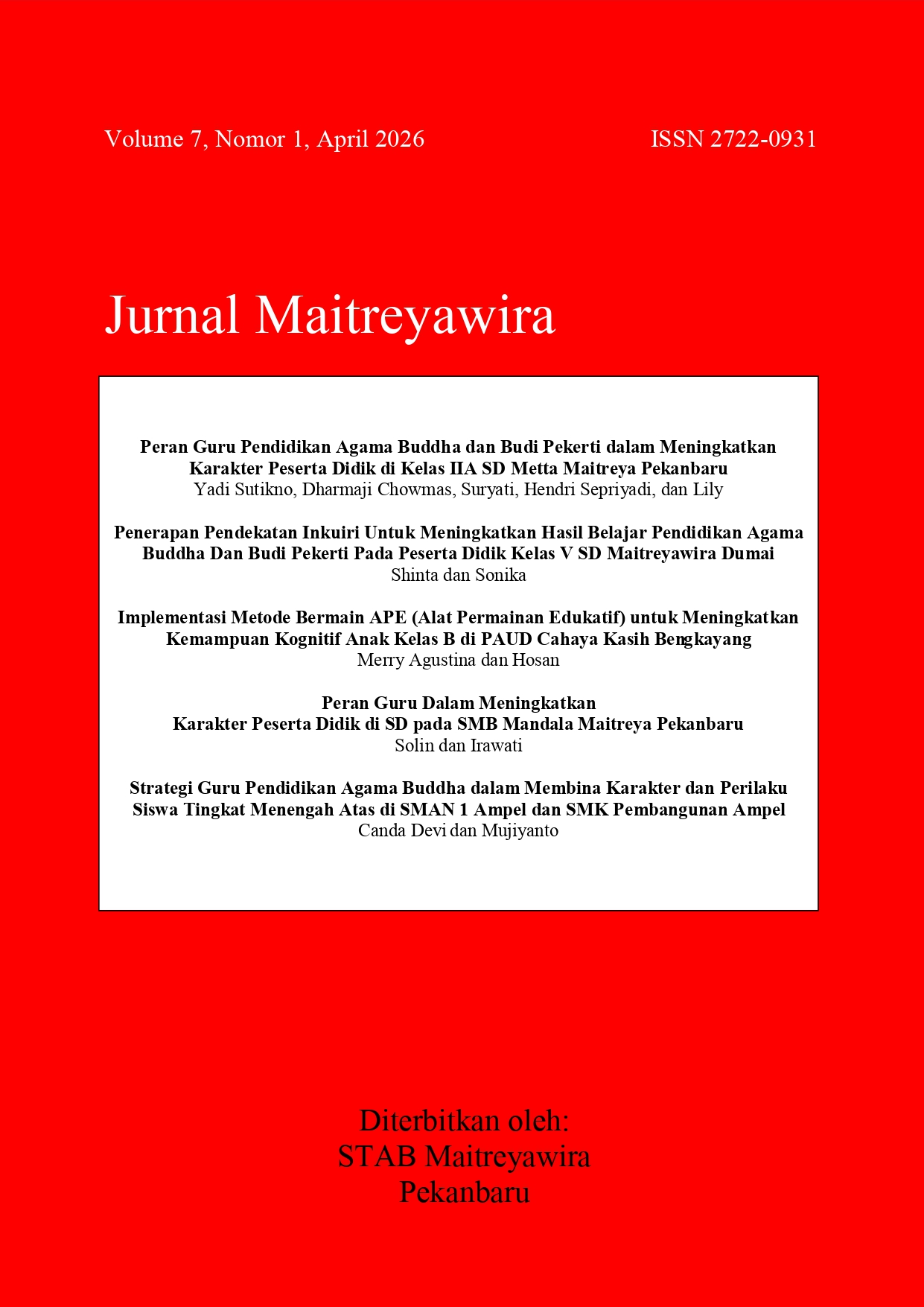
Strategi Guru Pendidikan Agama Buddha dalam Membina Karakter dan Perilaku Siswa Tingkat Menengah Atas di SMAN 1 Ampel dan SMK Pembangunan Ampel
DOI:
https://doi.org/10.69607/411efh85Keywords:
teacher strategy, Buddhist education, student character, mindfulness, collaborationAbstract
This study aims to describe the strategies used by Buddhist Education teachers in fostering students’ character and behavior at SMAN 1 Ampel and SMK Pembangunan Ampel, Boyolali, amid the challenges of the digital era. This qualitative case study involved three Buddhist Education teachers as key participants through in-depth interviews, participatory observations, and document analysis. The findings reveal that character building is implemented through five main strategies: teacher exemplarity, integration of Buddhist values into the curriculum, habituation through extracurricular activities, continuous behavior assessment and monitoring, and collaboration with parents and school institutions. Teachers act as moral guides who internalize the values of sīla (morality), samādhi (concentration), and paññā (wisdom) in the learning process. Furthermore, reflective and collaborative approaches involving students, families, and communities are effective in promoting discipline, mindfulness, and social responsibility. This research concludes that Buddhist Education teachers’ strategies are contextual and adaptive to technological development, providing a holistic model for character education in public schools.
Downloads
Published
Issue
Section
License
Copyright (c) 2026 Canda Devi, Mujiyanto Mujiyanto

This work is licensed under a Creative Commons Attribution 4.0 International License.