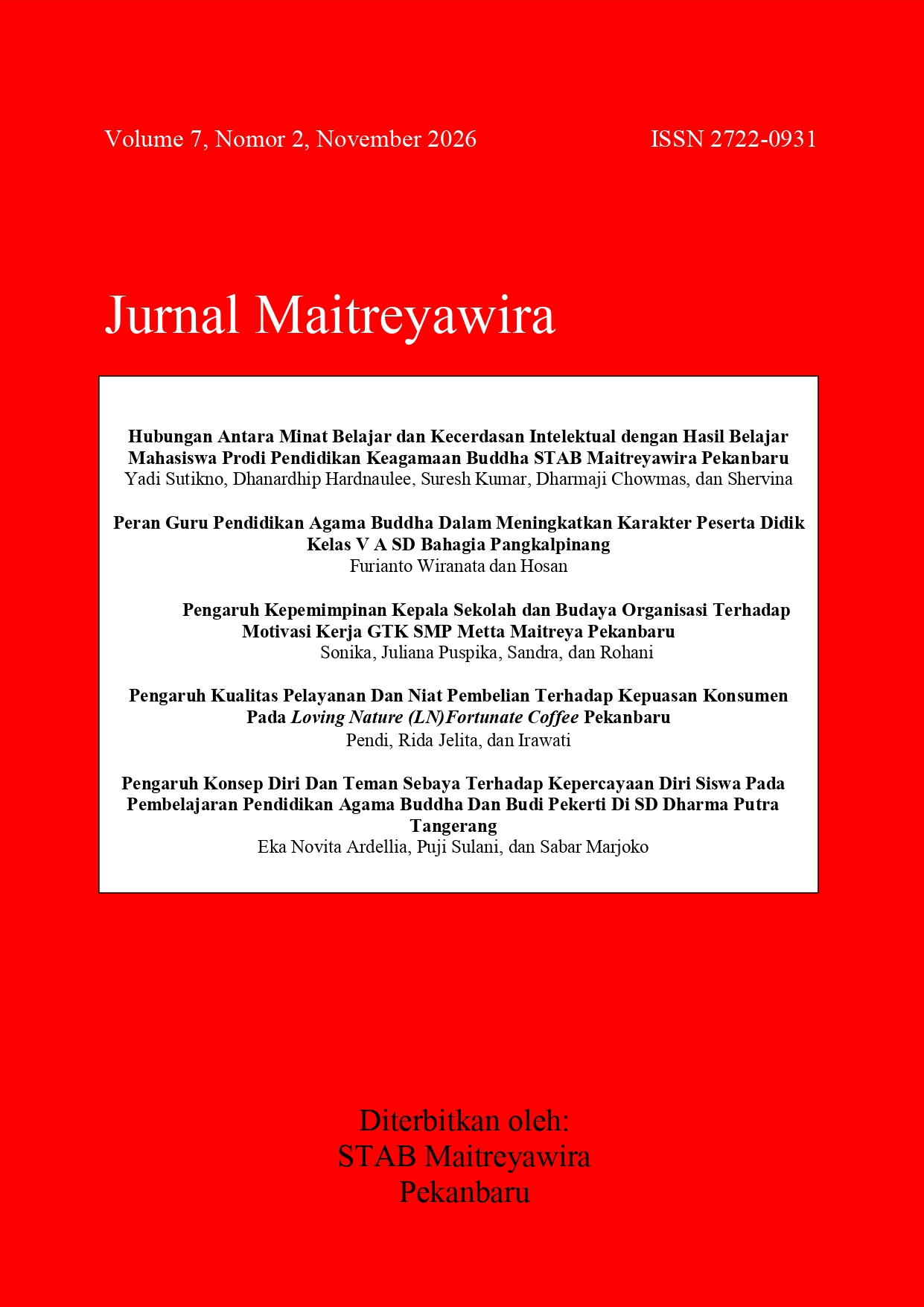
Peran Guru Pendidikan Agama Buddha Dalam Meningkatkan Karakter Peserta Didik Kelas V A SD Bahagia Pangkalpinang
DOI:
https://doi.org/10.69607/fj1x9c43Keywords:
Role Teachers, Character, Discipline and MannersAbstract
This study aims to describe the role of Buddhist religious education teachers in improving the character of class V A students at Bahagia Elementary School, Pangkalpinang. This study uses a descriptive qualitative method. The data collection techniques used were interviews, observation, and documentation. The data sources for this study were from the Vice Principal for Student Affairs, the Buddhist Religious Education Learning Educator for Class V A of Bahagia Pangkalpinang Elementary School, and Three V A Students of Bahagia Pangkalpinang Elementary School. Data analysis was conducted using the interactive data analysis technique of Miles and Huberman. The results of the study indicate that the role of Buddhist religious education teachers is very important in improving the character of discipline and good manners of students. The role of Buddhist religious education teachers is very effective in shaping the character of discipline and good manners of students. Discipline is the ability to control behavior, follow rules, and be responsible for actions and obligations. Then, good manners are attitudes, behaviors, or actions carried out to respect and appreciate others. By understanding the established procedures and rules, students can learn to hone discipline and good manners that are important in everyday life. Through research on students, they can bring their positive mindsets and habits into their daily lives, and become more disciplined and well-mannered individuals.
Downloads
Published
Issue
Section
License
Copyright (c) 2026 Furianto Wiranata, Hosan Hosan

This work is licensed under a Creative Commons Attribution 4.0 International License.